Congratulations to top historians and podcasters Tom Holland and Dominic Sandbrook on their recent podcast on the history of beards. Their podcast, The Rest is History, has taken the podcast world by storm, featuring in the top handful of podcasts in numerous rankings. In June, the Telegraph reported that it has had 200m downloads, and it has spawned a monthly subscription club for additional content and a chat community, two books and a live tour.

Ancient historian Tom Holland, well known in Christian circles for his book Dominion, and modern historian Dominic Sandbrook discuss an immensely varied range of historical topics from the profound to the frivolous. And so, it was natural that they undertook a two-part mini-series on the history of the beard.

Mouse can report that it was overall well-researched and entertainingly presented. Key aspects of beard history were suitably covered. They began, as Mouse's Beard Theology does in the cradle of civilisation in Mesopotamia, where kings would wear long beards to show their status as manly warriors, but priests would shave to present themselves as pure before the gods. They cover Roman and Greek beards, with a strong showing from top ancient historian Holland on point.
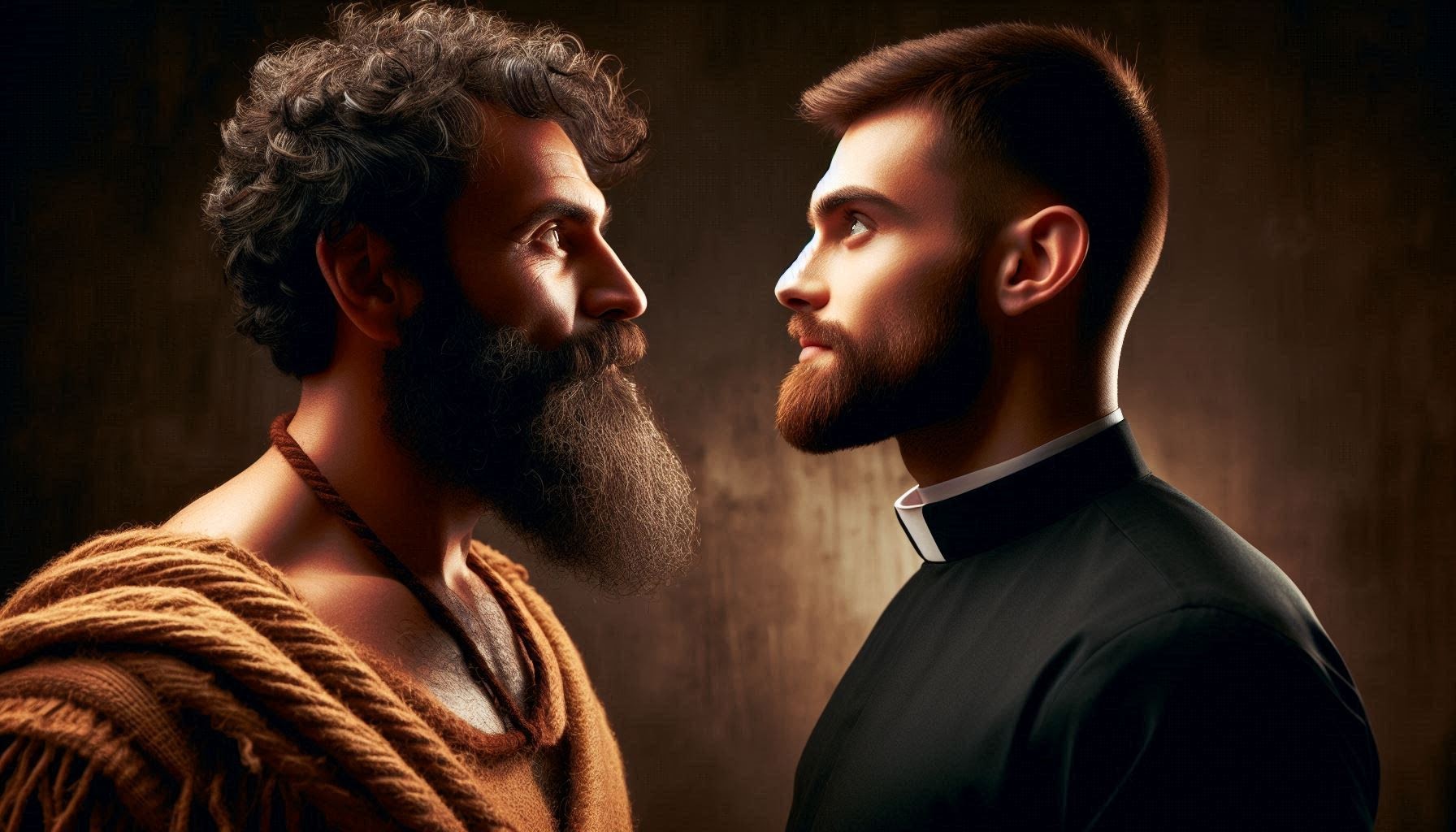

The series moved swiftly into the modern period. Had there been more time available they might have dwelled longer on the split between the Latin and Orthodox Church in 1054 in which the beard featured strongly. For Mouse, that story is emblematic of the role of beards through history - as markers of identity. 

The story Holland and Sandbrook told about the modern era was focused more into fashion than theology, which is understandable. However, there remains a theological underpinning which could have been explored further with more time. With the space Mouse had in his book to expand on the topic he was able to tell more of the story through the medieval period, where the first beard theology was written by Abbot Burchard who theorised that priests should shave their outer beard as a sign of humility but develop their 'inner beard'.

The modern church had an uneasy relationship with the beard through the 1960s and 70s when it was emblematic of rebellious sub-cultures, before making its peace with the beard eventually leading to Archbishop Rowan Williams winning the coveted Beard of The Year trophy.

Mouse highly recommends The Rest is History in general and these episodes in particular. And if you enjoy it why not expand on it with Mouse's Beard Theology where you can also read about Henry VIII's beard-growing competition with Francis I of France, why the Devil has a beard and many other entertaining tales.

Image created with Microsoft Designer AI

Beard Theology is out now in America. If you are based on the western side of the Atlantic you can buy a copy from the usual outlets, such as Amazon, Barnes and Noble and lots of really cool independent bookshops.


 The paperback edition of Beard Theology is now available from all good bookshops (and some rubbish ones, I would imagine).

It is great to finally get my paws on some physical copies of the paperback. Get hold of your copy from your chosen bookseller.


Over on twitter and Facebook, Mouse is hoping to lift a few spirits with a lockdown give-away. To win a signed copy of Beard Theology plus a print of one of Dave Walker's wonderful illustrations, signed by Dave, simply Retweet or Share the competition posts. For a bit of fun, why not also add your own caption to the picture.

Here is the illustration that I'll be giving away, signed in an A4 sized print.

I'll keep the giveaway open until Sunday 3rd May. Good luck!


Small print

I'll do my best to be fair for all entries. This is how I will do it: anyone who Retweets or Shares the post will be assigned a number by Mouse, then I'll use a random number generator to pick the winner. If you share on Facebook or Retweet on twitter but have the permissions set so that I can't see who you are, then I won't be able to enter you so please check that, particularly on Facebook. Also, I won't enter people who just click 'Like' or the heart icon on twitter - only Retweets and Shares.


UPDATE

The results my my lock-down giveaway have been counted and checked. I have (laboriously) collated everyone who retweeted on Twitter or shared here on Facebook, assigned a number to each and used Google random number generator to pick a winner.

Congratulations to @revraych on Twitter! You are the winner of this unique prize. Sorry everyone else. You are all winners in other ways.

The good news is that you can still “win” a copy from your bookseller of choice for a very reasonable price!

The Mouse was somewhat surprised to read the thoughts of Albert Mohler, President of the Southern Baptist Theological Seminary, on Beard Theology. He came down firmly on the side of the early Church fathers, in Beard Theology terms.

Let me explain.

Albert Mohler is evangelical royalty in the US. His seminary has over 3,000 students and is one of the largest in the world, supplying pastors into the largest Christian denomination in America. For those who are not familiar with them, the Southern Baptists are also fiercely conservative, dominating the Bible Belt.

Mohler has a hugely influential daily briefing on his website in which he muses on a current affairs from a theological perspective. Naturally, he picked up the key issue of beards on his 6 March edition.

The trigger for this was the widely discussed (in some places) appearance of facial hair on the chin of Canadian Prime Minister Justin Trudeau. Mohler saw the opportunity to reinforce his perspective on the created order:

the biblical worldview just reminds us of the basic fact that God made human beings as male and female and it matters. It even matters when it comes to facial hair. Whether a man has that facial hair as a beard and wears it or shaves it off in any regard, it points out that a man is a man and a woman is a woman. Now, of course you can try to interfere with that by pharmaceutical means or hormones, but the basic fact is a man's going to show up as a man in the face and the same thing is true of a woman.

Now let's compare this to the view of Clement of Alexandria on Beards, from The Instructor written in around AD200:
for God wished women to be smooth and to rejoice in their locks alone growing spontaneously, as a horse in his mane. But he adorned man like lions, with a beard, and endowed him as an attribute of manhood, with a hairy chest – a sign of strength and rule
Remarkable, isn't it.

However, the two theologians appear to come to different conclusions from here. Clement went on, "it is therefore impious to desecrate the symbol of manhood, hairiness". He argued that it was 'womanly' for men to comb your hair and shave. Men should let nature take its course on themselves and avoid all vanity in attempting to tame it. He argued that all Christian men should sport as bushy a beard as nature permitted.

Mohler on the other hand concluded, "Whether to have or have not a beard is a matter for individual male decision with a good deal of input, I would add, from the significant women in their lives." Whilst he argued the decision to shave or not to shave had meaning, he argued that this meaning may vary in different contexts so there is no 'right' answer on the facial hair question. 

I found it surprising that Mohler did not mention that he himself has decided to shave or comment on what he felt that meant. Or that until recently, Southern Baptist seminaries, like the one he runs, banned students from wearing beards because they thought they represented a rebellious 'hippie' spirit.

"A beard is not just a beard"

What Mohler rightly identifies is that beards do carry meaning, commenting 'a beard is not just a beard'. This is a very accurate statement through all recorded history. In my book I trace that meaning through a wide range of cultural contexts, from the earliest civilisations on earth to today. All the worlds major religions have views on beards.

Mouse is delighted that such a prominent theologian has visited this crucial topic. And there is so much more to be said. A little more recent history could have described the Catholic prohibition on beards and the claim that this was introduced by St Peter himself, for example. The Biblical stories and law on beards could have been expounded. Well, don't get me started. I have so many stories.

But perhaps Mr Mohler either has not researched the subject or did not have time and space to expand further.

But the rewards for those who do are truly wonderful. Enjoy Beard Theology folks. 


Mouse couldn't help sharing the latest high street retailer to stock Beard Theology - fashion outlet, New Look. Mouse is impressed with their promotional photography and wishes them the very best promoting an ideal fashion accessory!


Mouse has penned an article for Premier Christianity about the history of Santa and why he has a beard.  It is a rather fun story which traces the history of Santa Clause back to St Nicholas and the totally separate history of Father Christmas. Obviously when you get back to a fourth century bishop, the question of facial hair gets theological. This story isn't in the book, so do head over and read it.


Much has been written about the traditional appearance of Santa and how we have come to a pretty common global image of a man in red robes with a long white beard and a big cuddly belly. This is often (wrongly) attributed to a certain brand of soft drink. But little has been written on why he has a beard. You may be surprised to learn that the reason for Santa's facial fur is theological.  >> Read More


The endorsement Mouse has long been waiting for! The UK's Beard Liberation Front has written a review of Beard Theology.

The Beard Liberation Front is the custodian of the prestigious Beard of the Year award, which gets a mention in Beard Theology as Rowan Williams is a past winner.

Many thanks to Keith Flett for taking the time to read the book and write the review. Read in full here.

Full marks then to the Church Mouse for writing a detailed guide to the issue of beards and religion and indeed to Dave Walker for providing some of the better beard related cartoons Ive seen recently.

The historic Catholic newspaper The Tablet has an article all about Beard Theology.

Melanie McDonagh begins the article,
NOT FOR THE first time, I find that an idea I had nursed for a book has actually been written. Beard Theology: A Holy History of Hairy Faces, by the blogger known as the Church Mouse, gives a spirited account of the ways in which men’s beards have been given theological significance.
She then goes on to admit that she hasn't actually read it yet, which is a little disappointing. Nevertheless, the article is decidedly on topic and worth a read.


An interview with The Church Mouse was published in the Church of England Newspaper. It was great fun talking with Colin and he thoroughly got into the spirit of things with this write up. Colin begins:

Interviewing a mouse is an unusual assignment. Especially when the said Mouse is something of an expert in theological matters. And even more so when the Mouse in question has an innovative insight into church life.
Listening to the perspective of the Mouse, the ‘Church Mouse’, is something of a challenge. Bending down to the mouse hole in the rather grand headquarters of Hodder and Stoughton, on London’s Embankment, was something of a challenge, being barely able to see or hear the Mouse, but the insights proffered were profound. So much so that they have made it into a new book about the place of the beard in church (and wider) history.


A nice review of Beard Theology from Premier Christianity magazine. I'm glad that they found 'joy' in the 'many diversions' through the book. It was fun to collect the stories that weave together through the history of Christianity to make up the book. I'm also happy with the opening line - 'a funny book in both senses of the word'. Too right!

The Church Times printed an extract from Beard Theology in their 16 August issue. The section was the one which posed the question whether men will have beards in heaven and is based on a medieval treatise Apologia de Barbis, the world's first book on beards!

The article included responses from two contemporary priests with varying facial hair on their perspectives, which was great fun. Check out the article for a sneak preview of the kind of thing you'll find in Beard Theology.


Today's Thought for the Day on BBC Radio 4's Today Programme was delivered by Rev'd Giles Fraser on the topic of Beard Theology. I gave Giles a copy of my book last week and he summarises a number of the themes superbly in just three minutes. If you're curious about what the book might contain, this acts as a great primer.

Many thanks for Giles for the mention at the start and for describing the book as 'surprisingly fascinating'.


Mouse made a rare public appearance on the wireless to discuss Beard Theology. It was a particular honour to be interviewed by William Crawley, a past winner of the All Ireland Beard of the Year award! You can listen in on BBC Sounds from about 27 minutes.


When I tell people that I have written a book about the religious history of beards, I usually get asked two questions.

The first one is 'really?'. Yes really.

The second is, 'why?'. Now that is a much better question.

The first part of my answer to that is simply because it is a darn good yarn. There are so many moments through the history of the church where you'll find yourself saying 'wow, I never knew that!' and moments when you will have to stop and laugh.

But the second part of my answer to the 'why' question is perhaps more important.

The Jews in Jesus's day thought it part of their religious duty to grow a beard - just as they would observe the kosher food laws. Church fathers like St Augustine and Clement of Alexandria thought it an essential part of Christian discipleship for men to grow a beard. As the eastern and western churches grew apart and eventually split in the Great Schism of 1054, one of the points of contention was a difference over beards and it became a point significant enough for popes and partriarchs to fight over. And protestant reformers and evangelical revivalists could be picked out by the hairiness of their faces.

So why on earth did they all think beards were so important?

Now we're getting to the really interesting question.

To answer that, we will find the revealing story of how cultural context gets imported into theology and our reading of scripture. We will see how divisions between 'us' and 'them' bring seemingly trivial issues to the fore when they become points of difference around which the groups can rally.

Sound familiar?

That is why I wrote a book on beards - because the story of our beard history tells us so much about ourselves. Those who do not know their beard history are bound to regrow it.

------------------------------
Beard Theology is available from all good book shops (and probably some rubbish ones too).
------------------------------
It is great to be able to finally announce the launch of Beard Theology. More news will follow here, but in the meantime you can pre-order (or 'order' as I call it) from all good book shops. And some rubbish ones, I expect. Beard Theology will be on the shelves from the start of August.

To stay up-to-date with all the news you can sign up for email updates at the bottom of the page.

Contact Form

Name

Email *

Message *

Essential data privacy notice

The Church Mouse pays homage to the gods of data privacy and GDPR and will never give your email address to anyone else or use it for any purpose other than sending you the latest posts from this website or replying to your messages.
 
Twitter Facebook